

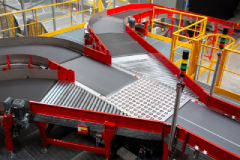

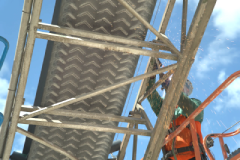


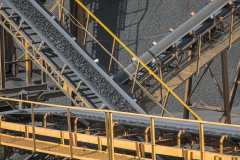
Transfer Point Dust Collection: Why Containment Has to Come First
There's a specific kind of frustration that comes from having already spent money on dust control and still having a dusty transfer point.
It's common, it's rarely the equipment's fault, and the cause is almost always the same: the collection was designed before the containment was.
What a dust collector actually does
A dust collector is a fan, a filter, and a hopper. It creates negative pressure at a pick-up point and pulls air through filter media, dropping the dust out and passing clean air through.
That's the whole mechanism, and the important word is air. The collector does not reach out and grab dust. It moves air, and it captures whatever the air happens to be carrying.
So the entire question is whether the air it pulls is the dust-laden air inside the transfer point, or clean room air that found an easier way in.
Air takes the path of least resistance, always. At a typical transfer point that path is not the pick-up duct. It's the gap: worn skirt rubber, an unsealed skirtboard, a chute that doesn't quite meet the pan, the open end of a load zone that was never enclosed. Room air pours in through the gap because the gap is easy, and the dust-laden air — pressurized by falling material — goes out through that same opening.
You get a running fan, a filter-change schedule, an electric bill, and a dusty transfer point.
Containment is the job, not the prep
The order of operations that actually works:
- Seal the load zone. Skirtboard, skirt rubber in good condition and correctly tensioned, wear liner, and seal geometry that closes the gap rather than covering it. Skirted and sealed are not the same thing, and most transfer points that get called "sealed" are only skirted.
- Give the material room to settle. Material entering a load zone is turbulent and moving. It needs a settling zone long enough to slow to belt speed before it reaches the end of the enclosure, otherwise it drags air with it and pressurizes the exit. Short load zones push dust out no matter what you do downstream.
- Enclose and lid it. Turn the transfer point into a contained volume with a defined opening for the pick-up rather than a series of accidental ones.
- Add curtains and stilling areas where the energy demands it. Impact crushers in particular — VSI and HSI — need the airflow slowed inside the enclosure before capture will work.
Only then does pulling air on it make sense. At that point the collector is doing what it was designed to do: maintaining slight negative pressure inside a contained volume so nothing escapes at the gaps, because there are no gaps.
What C&W built
C&W DustTech has been building dry dust collection systems since 1978. At ConExpo 2026 they released a collector designed specifically for this application — a compact unit that mounts directly on an enclosed belt conveyor transfer point instead of requiring a central collector and a long duct run.
The specifics:
- CP1335-CVY — 24" belt, 850 CFM @ 6.0" W.C., 3.0 HP, four 8" cartridges, 210 sq ft of filtration area
- CP2000-CVY — 30" and 36" belts, 1,500 CFM @ 6.0" W.C., 7.5 HP fan, six 8" cartridges, 315 sq ft
- CP2665-CVY — 42" and 48" belts, 2,000 CFM @ 6.0" W.C., 10 HP fan, eight 8" cartridges, 420 sq ft
All three use 100% spunbond polyester pleated cartridge media cleaned by reverse pulse jet, with a timer-controlled cleaning cycle. The mounting flange adjusts for conveyors up to 19 degrees of incline and includes 4-by-4 metal grating so foreign objects can't drop onto the belt.
Suitable applications are compression crusher discharge on jaw and cone crushers, screen discharge, and conveyor-to-conveyor transfer. It can also be used with VSI and HSI impact crushers when paired with proper load zone design including stilling areas and dust curtains.
The three requirements that matter
The installation requirements tell you more about this product than the spec table does.
- A fully enclosed transfer point with a lid. Non-negotiable. The collector mounts to the enclosure, and without the enclosure there's nothing to hold negative pressure.
- Five CFM of clean, dry compressed air at 90 to 100 PSI. That's a real plant utility question, not a checkbox. Air quality determines whether the cleaning system works at all — moisture in that line turns dust cake into a bonded layer that won't pulse off.
- Weight carried by the ground or the conveyor structure. These units run from roughly 480 pounds empty on the smallest model to about 1,250 pounds on the largest with loaded filters. Somebody has to confirm the structure takes it and, usually, fabricate the support that does.
Notice that none of those three are dust collection problems. They're conveyor, fabrication and structural problems.
Why this is a Davis product
We'll be direct about why we're enthusiastic about this particular piece of equipment: it can't be sold out of a catalog.
To put one in service, somebody has to assess and seal the load zone, design or extend the settling area, fabricate the enclosure and lid, verify and build the structural support, sort out compressed air quality, install and commission the unit, and then maintain the whole assembly on a schedule.
That's a conveyor service company with a fabrication shop. We run one — carbon steel, stainless, aluminum, AR plate, press brake, plate rolling, shear, ironworker, CNC plasma, certified welders, bondable.
C&W brings the dust engineering: airflow analysis, engineered site studies, air permit calculations, and direct access to their applications engineers for sizing. We bring the transfer point.
On silica and engineering controls
Operations handling stone, sand, gravel, concrete and similar materials are managing respirable crystalline silica exposure, and rules in this area continue to move. Portions of MSHA's silica rulemaking remain in litigation as of this writing, so we won't tell you what your obligations are — that's a conversation for your own safety and legal counsel.
What hasn't changed, and isn't in dispute, is the hierarchy of controls: engineering controls come before personal protective equipment. Capturing dust at the transfer point, before it reaches the breathing zone, is an engineering control. Respirators are not a substitute for one.
Controlling dust at the source is the right answer regardless of how the litigation resolves.
Start with the transfer point you've given up on
Every plant has one. It's usually been skirted twice, and it's still dusty.
Davis Industrial will walk it with you at no cost and tell you what we see — including whether the honest answer is a containment fix rather than an equipment purchase. Frequently it is.
Schedule your free site walk at conveyors247.com, or call 813-247-3620.