



Dust Isn't a Housekeeping Problem. It's a Conveyor Problem.
Walk almost any plant that handles dry bulk material and you'll find the same quiet arrangement. There's a spot — usually a transfer point, sometimes a screen discharge — that everybody knows is dusty. It has been dusty for years. Somebody sweeps it. It's on a list somewhere as housekeeping.
That arrangement is expensive, and the expense is almost entirely invisible, because it never gets coded to the thing causing it.
The floor is the least interesting place that dust ended up
Fugitive dust doesn't choose the walkway. It goes everywhere air goes, and the walkway is simply where you notice it.
The same dust is settling on your return idlers. Material caking on a return roll changes its effective diameter, and a roll that isn't round anymore is a tracking problem developing in slow motion — one that shows up weeks later as belt edge damage that looks like it came from nowhere.
It's working past bearing seals. Abrasive fines in a bearing do exactly what abrasive fines do. That's not a dust problem in your maintenance records; it's a bearing that failed early for no documented reason.
It's on the belt cleaner blade, interfering with the clean contact the cleaner needs to work, which produces carryback, which produces more dust. Dust generation is self-reinforcing that way.
It's in your motors, your drives, your electrical enclosures. It's loading whatever air permit your facility operates under. And the fraction of it fine enough to stay suspended is in the breathing zone of the people working there.
Sweeping addresses precisely one of those.
Visible dust and respirable dust are two different problems
This distinction is worth internalizing because it changes what "clean" means.
The dust you can see is mostly coarse. It's heavy enough that gravity wins, which is exactly why it lands on surfaces and why sweeping works on it. It's a nuisance and it's a housekeeping cost.
The fraction that matters most for worker exposure is the fraction that doesn't land. Respirable particulate stays suspended in air and is small enough to reach deep into the lungs. It does not settle out of a room on its own.
Which means a plant can look genuinely clean and still have an airborne exposure question — because the two behave differently. Visual inspection tells you about the coarse fraction. It tells you very little about the fine one.
This is also why filter media selection is not a minor spec decision. Traditional felt bag media is typically rated for 2 micron and larger at 99.9% efficiency. Spunbond polyester cartridge media is rated for 0.5 micron at 99.9%. (Both figures at standard test conditions.) The gap between those two numbers is precisely the size range where the airborne fraction lives.
Dust has three addresses
Here's the part that should interest anyone who owns a conveyor system.
Fugitive dust is not generated evenly across a plant. It's generated where material changes direction, changes elevation, or falls. In practice that means three places:
- Compression crusher discharge — jaw and cone crushers, where material exits under pressure.
- Screen discharge — where sized material drops off the deck.
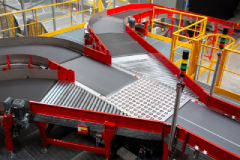
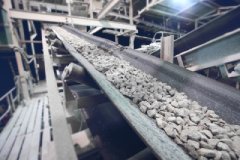
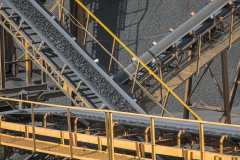
- Conveyor-to-conveyor transfer — where one belt loads another.
Impact crushers, VSI and HSI, generate dust the same way but need more design attention because of the energy involved — proper load zone design there means stilling areas and dust curtains, not just an enclosure.
Look at that list again. It isn't a housekeeping map. It's a conveyor map. Every one of those locations is a piece of equipment that a conveyor service company already works on, already understands, and already has parts for.
That's the argument for bringing the conveyor people into the dust conversation at the beginning rather than after a collector has already underperformed.
Why "buy a collector" isn't the answer by itself
A dust collector works by pulling air. It creates negative pressure at a pick-up point and draws dust-laden air through filter media.
That only works if the air it pulls is the air with the dust in it. Aim a collector at an open transfer point and the path of least resistance is whatever gap you didn't seal — the worn skirt rubber, the open end of the load zone, the chute that doesn't quite meet the pan. Room air rushes in through the gap, and the dust rides out through the same opening. You'll run the fan, buy the horsepower, change the filters, and still have a dusty transfer point.
Containment isn't preparation for dust collection. Containment is dust collection. The collector handles the last portion of the job, after sealing, settling zone design, and enclosure have done theirs.
Where to start
You don't need a study to find your worst transfer point. Everybody already knows which one it is.
Davis Industrial offers a free site walk. A solutions specialist walks your system with you, looks at load zones, sealing, skirting, chute work, transfer points and existing collection, and gives you a written read on what they find — including the parts that are working fine.
We handle containment, fabrication, ducting, installation and service in house, and through our partnership with C&W DustTech we bring nearly five decades of dust collection engineering — airflow analysis, engineered site studies and air permit calculations — behind the equipment side.
Schedule your free site walk at conveyors247.com, or call 813-247-3620.